Your dashboard says you sold Rs 2.4 million last month. Your bank account says you received Rs 2.1 million. Where did the other Rs 300,000 go?
For most online sellers in Pakistan, the honest answer is: nobody is quite sure. Some of it is gateway fees. Some is COD that a courier still holds. Some are refunds, a few are failed card payments that showed as "successful" in a plugin and a small part may be a genuine error or loss.
Payment reconciliation is the process that answers that question, order by order, rupee by rupee.
This guide explains what it is, how it works step by step and how Pakistani businesses can stop doing it by hand in spreadsheets.
What Is Payment Reconciliation?
Payment reconciliation is the process of matching every payment you expected to receive against the money that actually arrived in your bank account, and explaining every difference.
In simple terms, you compare three records:
- What you sold — orders in your store, OMS or POS.
- What was collected — transactions recorded by your payment gateway, wallet provider or courier (for COD).
- What was settled — the credits that landed in your bank account after fees, taxes and deductions.
When all three agree, an order is reconciled. When they don't, you have an exception to investigate: a missing payment, a short settlement, a duplicate charge, a refund, or a chargeback.
Reconciliation is not the same as bookkeeping. Bookkeeping records transactions. Reconciliation proves those records are correct and that your cash position is real.
Why Reconciliation Is Harder for Pakistani Businesses
A typical Pakistani online store collects money through four or five channels at once, and each one settles on a different timeline, in a different format.
The shift to digital is real. According to the State Bank of Pakistan, digital channels handled 92% of retail payments by volume in January–March 2026, and Raast alone processed 742.1 million transactions worth Rs 23.3 trillion in that quarter. Raast person-to-merchant payments rose to 55.9 million, up from 36.3 million the quarter before (Profit).
But eCommerce checkout is still COD-heavy. So a single merchant now juggles:
- Card payments settled by a gateway in batches, net of MDR fees.
- Mobile wallets (JazzCash, Easypaisa) with their own reports and settlement cycles.
- Raast and IBFT transfers that arrive instantly but often without an order reference.
- Cash on Delivery collected by riders, remitted by couriers days later, minus delivery charges and returns.
- Partial or upfront payments on COD orders, where one order is paid in two parts through two channels.
Every extra channel adds a new file to download, a new date to track, and a new way for money to go missing. Without a reconciliation process, cash cycle time stretches, COD leakage goes unnoticed, and profit per order becomes a guess.
Types of Payment Reconciliation
Most businesses need all five of these. Each one answers a different question.
| Type |
What you match |
Question it answers |
| Order-to-payment |
Store orders vs gateway or wallet transactions |
Did every paid order actually get paid? |
| Gateway-to-bank |
Gateway settlement report vs bank credits |
Did the gateway pay out everything it owes, minus the right fees? |
| COD reconciliation |
Delivered COD orders vs courier remittance |
Did the courier send all cash collected, net of agreed charges? |
| Refund and chargeback |
Refunds issued and disputes vs deductions in settlements |
Were refunds and chargebacks deducted correctly, and only once? |
| Bank reconciliation |
Bank statement vs accounting ledger |
Does the cash in the books match the cash in the bank? |
For Pakistani sellers, COD reconciliation and gateway-to-bank reconciliation are usually where the biggest gaps hide, because both involve a third party holding your money for several days.
How Payment Reconciliation Works: Step by Step
Whether you do it in Excel or through software, the process follows the same six steps.
- Collect the records. Export orders from your store or OMS, transaction reports from your gateway and wallets, COD remittance statements from couriers, and your bank statement for the same period.
- Standardise the data. Put every file in one format: order ID, transaction ID, date, gross amount, fees, net amount, payment method and status. Convert dates and remove duplicates.
- Match transactions. Link each order to its payment using a unique key. The order ID is best; the transaction ID or amount-plus-date is a fallback. Then link each batch settlement to the bank credit.
- Account for deductions. Subtract gateway MDR, wallet charges, courier delivery fees, withholding tax and any refunds, so you compare net to net, not gross to net.
- Flag and investigate exceptions. Anything unmatched goes on an exception list: missing payments, short settlements, duplicates, unclaimed transfers or returns not reversed.
- Resolve, record and close. Raise disputes with the gateway or courier, post adjustments to your ledger, and mark the period as reconciled. Track open exceptions until they are cleared.
The ideal frequency is daily for payments and weekly for COD. Monthly reconciliation finds problems too late to recover the money.
A Worked Example: One Week at a Lahore Fashion Store
Here is how a Rs 81,025 gap between sales and bank credits breaks down once you reconcile it. The figures are illustrative.
The store booked 100 orders worth Rs 500,000: 30 by card (Rs 150,000), 10 by mobile wallet (Rs 40,000) and 60 on COD (Rs 310,000). The bank received Rs 418,975.
| Line |
Amount (Rs) |
Finding |
| Card order marked "paid" by the store plugin but declined at the gateway |
5,000 |
Exception: shipped without payment |
| Gateway fees (2.5% on Rs 145,000) and wallet fees (1% on Rs 40,000) |
4,025 |
Expected, matches the agreed rates |
| COD orders returned (9 parcels) |
45,000 |
Expected, no cash collected |
| Courier delivery charges (60 parcels at Rs 250) |
15,000 |
Expected, matches the rate card |
| Two delivered COD orders missing from the courier remittance |
12,000 |
Exception: raise with the courier |
| Total gap explained |
81,025 |
|
Without reconciliation, the owner sees a vague "16% shortfall". With it, they see two specific problems worth Rs 17,000: a checkout bug and an unremitted COD claim. Both are fixable, and both would repeat every week if left alone.
Common Reconciliation Mismatches and What Causes Them
Most exceptions fall into a handful of repeat patterns. Fix the cause and the exception stops coming back.
| Mismatch |
Likely cause |
How to fix it |
| Order marked paid, no payment received |
Redirect checkout lost the callback; customer closed the bank page |
Use on-site checkout with server-side payment confirmation |
| Settlement lower than expected |
Fee rate differs from contract; withholding tax not accounted for |
Check the fee line by line against the agreed MDR |
| Payment received, no matching order |
Raast or IBFT transfer with no order reference |
Use payment links tied to an order ID |
| Duplicate charge |
Customer retried after a timeout |
Idempotent payment requests; auto-refund duplicates |
| COD delivered, cash not remitted |
Courier delay, rider shortage, data mismatch |
Weekly COD reconciliation by tracking number |
| Refund not reflected |
Refund issued in store but not processed at the gateway |
Issue refunds from the gateway dashboard, not manually |
| Chargeback deducted without notice |
Dispute raised by the card issuer |
Monitor disputes daily; keep delivery proof |
Notice that most of these causes start at checkout, not in accounting. Clean payment data at the point of sale is what makes reconciliation fast later.
How a Unified Gateway Like XPay Makes Reconciliation Easier
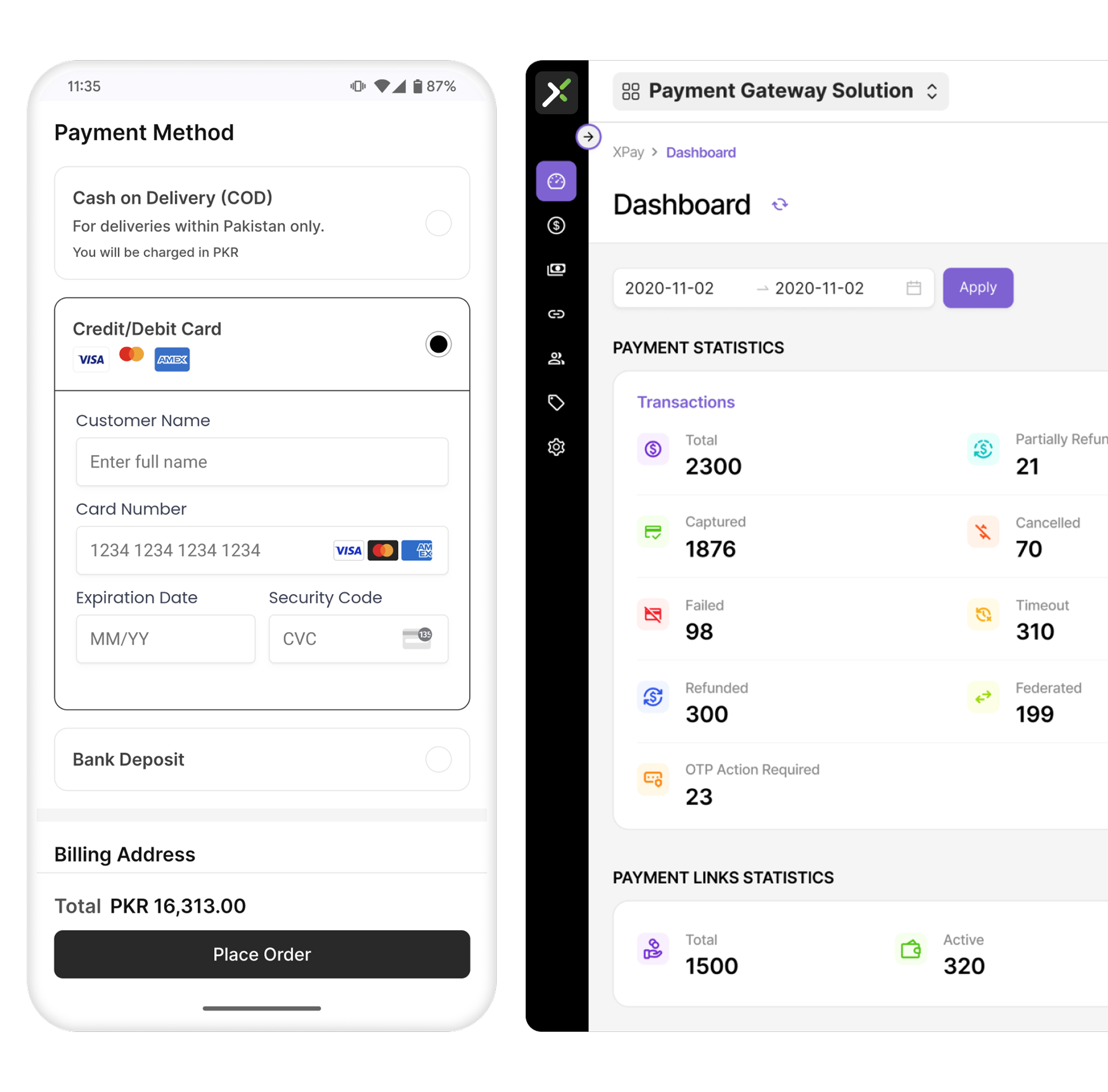
The fastest way to simplify reconciliation is to collect more of your payments through one system that ties every rupee to an order. That is the approach behind XPay by PostEx, a PCI-DSS certified payment gateway built for Pakistani businesses.
Here is how its features map to the mismatches above:
- One API for every payment method. XPay accepts cards, wallets, bank transfers, Google Pay and COD through a single integration. Fewer sources means fewer reports to download and match.
- On-site checkout with no redirects. Customers pay without leaving your store, which cuts the lost-callback problem that creates "paid but unpaid" orders.
- Payment links for chat-based selling. Instead of asking WhatsApp and Instagram customers for a bank transfer and a screenshot, send a link tied to the order. The payment arrives already matched.
- Payment on Delivery. On PostEx deliveries, customers can pay the rider by QR or debit/credit card at the doorstep, with instant confirmation. Digital COD means less cash handling and a cleaner record than rider-collected cash.
- Dynamic routing to control fees. Payments are routed to the most efficient channel. PriceOye reports cutting gateway fees by 30% this way, which makes the fee line in your reconciliation smaller and more predictable.
- XShield fraud engine. Risky transactions are flagged using email, phone, BIN, IP and card fingerprint, which means fewer chargebacks turning up as surprise deductions.
- Plug-ins for Shopify, WooCommerce and custom platforms. Orders and payments stay linked from day one, without custom coding.
XPay also lists transparent pricing with no hidden fees, which matters because unexplained fees are one of the most common reconciliation gaps. Merchants can start collecting payments in about 30 minutes.
Best Practices for Pakistani Sellers
Small habits make reconciliation take minutes instead of days.
- Use one unique order ID everywhere. It should appear in your store, gateway, courier booking and payment link.
- Reconcile payments daily and COD weekly. Short cycles keep exceptions small and recoverable.
- Know your contracted rates. Keep MDR, wallet fees and courier rate cards in one sheet so you can spot overcharges.
- Push customers toward prepaid. Offer a small discount for card or wallet payment. Every prepaid order is one less COD remittance to chase and one less return risk.
- Never ship on a screenshot. Confirm transfers in your bank or gateway before dispatch.
- Separate business and personal accounts. Mixed accounts make bank reconciliation almost impossible.
- Keep an exception log. Record each mismatch, its cause, owner and resolution date.
KPIs to track
| KPI |
What it tells you |
| Match rate (% of orders auto-matched) |
How clean your payment data is |
| Open exceptions (count and Rs value) |
How much money is currently unexplained |
| Days to settlement |
How fast each channel turns sales into cash |
| COD remittance gap (Rs) |
Cash collected but not yet received from couriers |
| Prepaid share of orders |
How much of your revenue avoids COD risk |
| Fees as % of GMV |
Whether payment costs are under control |
Frequently Asked Questions
What is payment reconciliation in simple words?
It is checking that the money you were supposed to receive for each sale actually reached your bank account, and explaining any difference.
How often should an online store reconcile payments?
Daily for card, wallet and bank transfers, and weekly for COD. Monthly is too slow to recover missing money from couriers or gateways.
What is COD reconciliation?
It is matching every delivered cash-on-delivery order against the courier's remittance, after delivery charges and returns, to confirm all collected cash was paid to you.
What is the difference between bank reconciliation and payment reconciliation?
Bank reconciliation matches your bank statement to your accounting books. Payment reconciliation goes further back and matches each order to its payment and settlement.
Can a payment gateway help with reconciliation?
Yes. A gateway that collects most payment methods in one place, links each payment to an order ID and confirms payments server-side removes many common mismatches. XPay does this for cards, wallets, bank transfers and COD on PostEx deliveries.
Why doesn't my settlement match my sales?
The usual reasons are gateway fees, taxes, refunds, chargebacks, failed payments marked as paid, and timing, where a sale today settles a few days later.
Conclusion
Payment reconciliation turns "I think we made money" into "I know where every rupee is." For Pakistani sellers handling cards, wallets, Raast and COD at once, it is the difference between growing on real numbers and growing on guesses.
Start with the basics: one order ID, daily matching and a weekly COD check. Then reduce the number of places your money comes from. If you want cards, wallets, bank transfers and doorstep digital COD under one roof, explore XPay by PostEx or book a demo to see how it fits your store.