BLOG
Raast Payments for Ecommerce: What Businesses Need to Know
See how Raast payments work, what P2M means for merchants and how ecommerce businesses can simplify digital payment acceptance.

Author
XPay
September 23, 2026
BLOG
See how Raast payments work, what P2M means for merchants and how ecommerce businesses can simplify digital payment acceptance.
September 23, 2026
Pakistan’s ecommerce payment ecosystem is changing quickly. Customers now have more ways to pay online, from cards and mobile wallets to bank transfers and instant payment systems.
One of the most important developments is Raast, Pakistan’s instant payment system developed by the State Bank of Pakistan. With its Person to Merchant or P2M service, Raast enables businesses to accept digital payments through QR codes, Request to Pay, merchant aliases and IBANs. SBP has also specifically enabled Raast P2M acceptance for ecommerce checkouts.
For ecommerce businesses, particularly Shopify merchants, this creates another way to accept payments directly from customers.
This guide explains how Raast payments work for ecommerce, what P2M, Dynamic QR and Request to Pay mean, and how businesses can incorporate Raast into their online checkout.
Raast is Pakistan’s instant payment system operated under the State Bank of Pakistan.
It was designed to make digital payments faster and more accessible across Pakistan. While Raast initially became known for person to person payments, its capabilities now extend to businesses through Raast Person to Merchant or P2M.
Through Raast P2M, merchants can accept payments using:
SBP's framework also requires participating institutions to support payment confirmation and mechanisms for returns and refunds.
For an ecommerce merchant, the important point is simple.
Raast can be used as a digital payment method at ecommerce checkout.
P2M means Person to Merchant.
It is the part of the Raast system designed specifically for businesses receiving payments from customers.
The basic payment flow looks like this:
Customer → Ecommerce Store → Raast Payment → Customer's Bank/App → Merchant
Unlike Cash on Delivery, the customer completes the payment digitally as part of the purchasing process.
SBP's Raast P2M framework supports QR-based payments, Request to Pay, IBAN and merchant aliases. It also specifically includes acceptance through ecommerce checkouts.
For businesses, this means Raast isn't limited to physical shops. It can also be part of an online payment experience.
A typical ecommerce Raast payment can work through the following steps.
The customer visits an online store, selects a product and adds it to the cart.
At checkout, the customer sees the available payment methods.
Depending on the merchant's setup, this can include cards, wallets and Raast payment options.
The customer chooses the available Raast option.
Depending on the implementation, this can involve a Dynamic QR or Request to Pay.
The customer completes the payment through their supported banking or payment application.
Once the transaction is confirmed, the merchant's payment system can update the transaction and continue the order process.
For ecommerce businesses, the important part is ensuring that the payment confirmation and order status remain synchronized.
A Dynamic QR is a QR code generated for a particular payment or transaction.
Instead of using the same QR code for every purchase, transaction information can be associated with the specific payment.
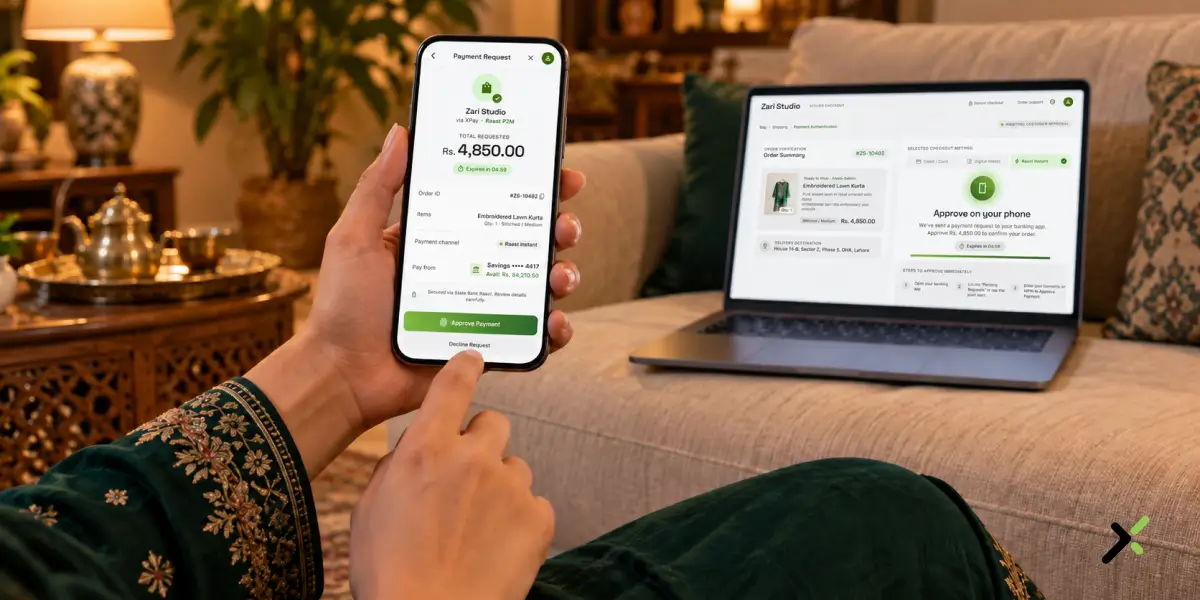
For example, imagine a customer is purchasing a product worth PKR 4,850.
The checkout can generate a payment-specific QR containing the information required to make that transaction.
The customer scans the QR using a supported banking or payment application, reviews the payment and authorizes it.
SBP's Raast P2M framework supports both static and dynamic QR codes for merchant payment acceptance.
For online merchants, transaction-specific QR payments can help connect:
Order → Payment Amount → Customer → Transaction
This can make payment identification and reconciliation more straightforward when implemented correctly.
Request to Pay or RTP allows a merchant or payment service provider to initiate a payment request for the customer.
Instead of manually entering payment details, the customer receives a payment request and approves it through their supported banking or payment experience.
SBP's Raast P2M framework defines two Request to Pay modes:
RTP Now has a shorter expiry period, while RTP Later provides a longer period for completing the payment.
For ecommerce, Request to Pay can provide another payment flow alongside QR-based payments.
Both methods can support digital merchant payments, but the customer interaction is different.
The right implementation depends on the merchant's payment setup, customer behavior and technology stack.
The growth of digital payments is creating more opportunities for businesses to move customers away from manual payment processes.
SBP's retail payment review for October to December 2025 reported 3.4 billion retail payment transactions, with 92% conducted through digital payment channels. During the same quarter, ecommerce platforms processed 305.1 million transactions worth PKR 422 billion.
Raast adoption has also grown significantly.
SBP reported 2.1 million merchants registered on Raast P2M during Q2 FY26. The same review reported 645.7 million Raast transactions worth PKR 18.5 trillion during the quarter.
These figures show why ecommerce businesses need to pay attention to the expanding digital payment ecosystem.
Customers do not all prefer the same payment method.
One customer may prefer a debit card.
Another may use a mobile wallet.
Another may prefer Cash on Delivery.
A bank account customer may prefer an instant account-based payment such as Raast.
Offering multiple payment methods gives merchants more flexibility when designing their checkout experience.
For ecommerce businesses, the goal is not necessarily to replace every existing payment method. Instead, merchants can build a checkout that supports the payment options their customers actually use.
Cash on Delivery remains an important payment method for Pakistani ecommerce.
The difference is that COD allows customers to pay when their order arrives, while Raast allows payment to be completed digitally during the purchase process.
Rather than treating them as competing replacements, merchants can offer both where appropriate.
A customer who prefers COD can continue using it, while customers comfortable with digital payments can select Raast or another available payment method.
Yes, Raast P2M is designed to support merchant payment acceptance, including ecommerce checkouts.
For Shopify merchants in Pakistan, the challenge is not simply having a payment method available. The payment method also needs to work correctly with the store's checkout, order processing and payment confirmation flow.
This is where payment integrations become important.
The PayFast Raast integration shown in the XPay Shopify experience supports Dynamic QR and Request to Pay as additional payment options for Shopify customers.
This gives merchants another way to present Raast during checkout while maintaining the Shopify purchasing flow.
XPay's Shopify offering also supports multiple compatible payment gateways, including PayFast, HBL and Meezan Bank, among others.
XPay by PostEx is built to help ecommerce businesses manage multiple digital payment options through a single payment solution.
XPay supports ecommerce platforms including Shopify, WooCommerce and custom platforms, while its current platform supports cards, wallets, bank transfers and other payment methods.
For Shopify merchants, XPay can provide:
Customers can complete their payment without being redirected away from the merchant's website.
An on site checkout can help maintain a consistent shopping experience throughout the payment process. XPay describes its checkout as designed to reduce payment friction and keep customers on the merchant's site.
XPay's Shopify integration supports multiple compatible gateways, allowing merchants to work with different banking and payment providers through the XPay ecosystem.
Depending on the merchant configuration, customers can access payment options such as cards, wallets, bank transfers and supported Raast payment options.
A centralized payment solution can also make it easier for merchants to monitor transactions and manage their payment operations.
Businesses considering Raast should look beyond simply enabling a payment button.
A reliable implementation should cover the complete payment journey.
Evaluate the available payment provider and check:
The payment provider may require business information and other documentation before activating payment services.
SBP requires Raast Merchant Service Providers to onboard businesses after completing appropriate due diligence.
For Shopify merchants, this typically involves installing or configuring the relevant payment integration and connecting the merchant account.
XPay's Shopify app supports multiple compatible gateways and provides a setup process for merchants.
Depending on the available setup, merchants can configure supported Raast methods such as Dynamic QR or Request to Pay.
Before going live, test:
Once the payment flow has been tested, monitor transaction success, customer behavior and payment issues after launch.
Adding a payment option is only one part of the process.
Businesses should also evaluate how the payment method fits into their broader operations.
Does the store receive confirmation after a successful transaction?
Does the ecommerce platform correctly update the order after payment?
Can the finance team match payments with individual orders?
What is the process for handling customer refunds?
SBP's Raast P2M framework includes provisions for customer initiated return and refund requests through the relevant Raast merchant interface.
Merchants should understand when and how funds are settled.
A useful payment system should provide sufficient transaction information for finance and operations teams.
Payment security should be considered alongside convenience. XPay states that its platform uses PCI DSS related protections for payment operations and provides fraud monitoring capabilities.
Raast is becoming an increasingly important component of Pakistan's digital payment infrastructure.
The numbers show continued growth. In Q2 FY26, SBP reported 33.6 million Raast P2M transactions worth PKR 167.6 billion.
For ecommerce businesses, this means payment strategy is becoming more important than simply choosing one payment method.
A modern checkout can combine:
Cards + Wallets + Raast + Bank Payments + Cash on Delivery
The exact combination depends on the merchant's customers, products, average order value and business model.
The important consideration is giving customers a payment experience that is convenient while ensuring the merchant can reliably confirm, reconcile and manage every transaction.
Raast is Pakistan's instant payment system developed by the State Bank of Pakistan. Its P2M service allows businesses to accept digital payments through methods including QR codes, Request to Pay, merchant aliases and IBANs.
Raast P2M stands for Raast Person to Merchant. It enables businesses to receive digital payments from customers through supported Raast payment methods.
Yes. SBP's Raast P2M framework specifically provides for merchant acceptance through ecommerce checkouts.
Raast P2M supports ecommerce checkout acceptance. Shopify merchants can use compatible payment integrations and providers to make supported Raast payment methods available to customers.
A Dynamic QR is a transaction-specific QR code that can be used by a customer to make a particular merchant payment.
Request to Pay allows a merchant or payment service provider to initiate a payment request that the customer can review and authorize.
No. Raast is an instant payment system and payment infrastructure. A payment provider or gateway can integrate supported payment methods into a merchant's ecommerce checkout.
Raast and COD serve different customer preferences. Merchants can offer Raast as a digital payment option while continuing to offer COD where it makes sense for their business.
Start by selecting a compatible payment provider, completing merchant onboarding, connecting the Shopify integration and configuring the available Raast payment options. Always test payment confirmation, order synchronization and refunds before going live.
XPay supports Shopify and multiple compatible payment gateways. Its Shopify integration is designed to give Pakistani merchants access to multiple payment options through a unified payment solution.
Raast is becoming an important part of Pakistan's digital payment infrastructure, and its P2M service gives ecommerce businesses additional ways to accept payments.
For online merchants, the opportunity is not simply about adding another payment button. The bigger consideration is creating a checkout that supports the payment methods customers want while keeping payment confirmation, order processing, refunds and reconciliation connected.
For Shopify merchants, Dynamic QR and Request to Pay can provide additional Raast payment experiences, while a payment solution such as XPay can bring multiple payment methods and compatible gateways into the ecommerce checkout.
If you're building or scaling an ecommerce business in Pakistan, adding more relevant payment options can help you create a checkout that is better aligned with how customers want to pay.
Ready to add more payment options to your Shopify store?
Get started with XPay and learn how you can connect your ecommerce store with supported digital payment methods.
Offer customers a faster, secure checkout experience without redirects. From cards and wallets to payment links. XPay helps you reduce drop-offs and get paid reliably.
Get Free Demo